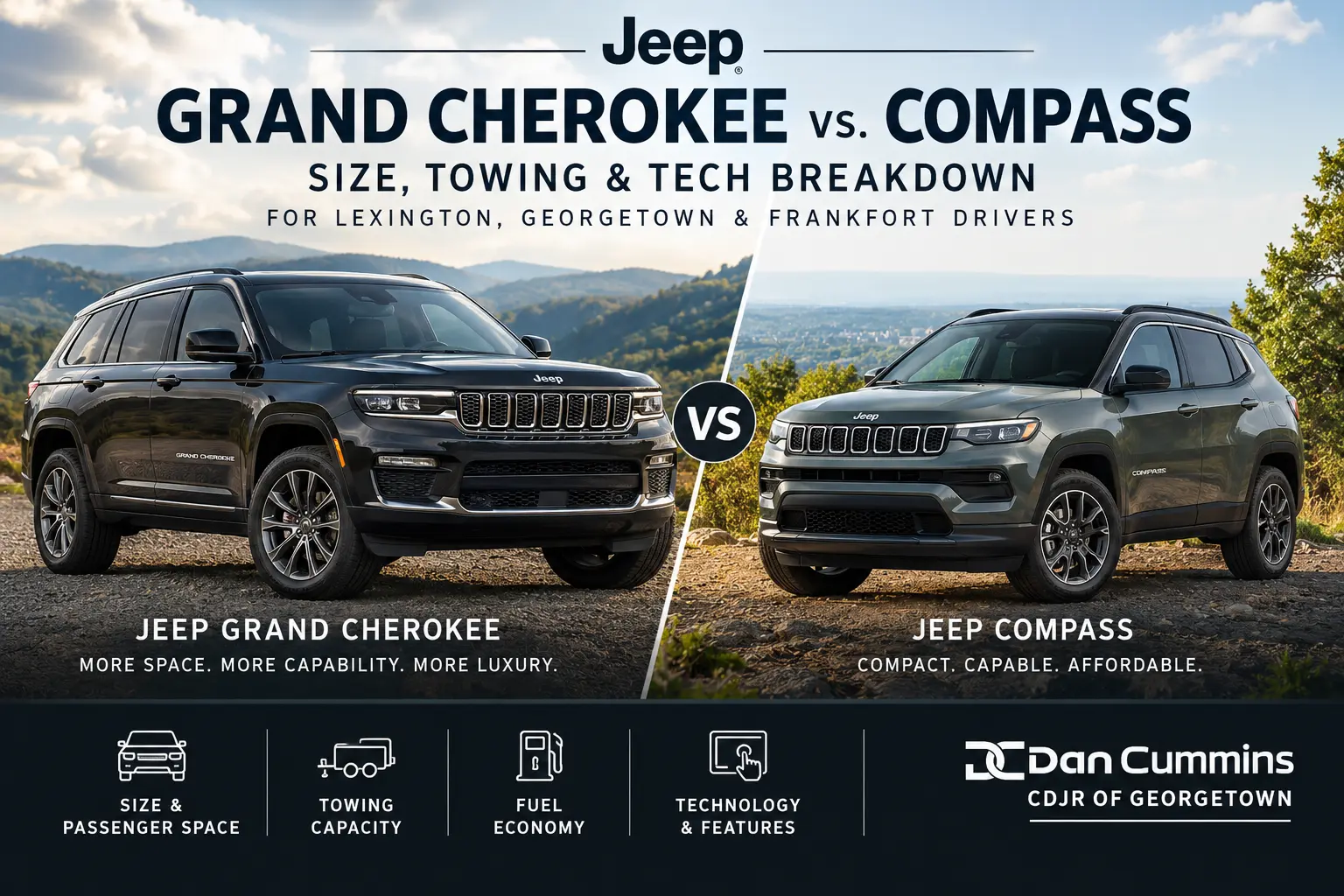
Jeep Grand Cherokee vs. Jeep Compass: Size, Towing, & Tech Breakdown Shopping for a Jeep SUV but can't decide between the Jeep Grand Cherokee and Jeep Compass? Both deliver the versatility and adventurous spirit Jeep is known for, but they serve different needs. The Compass is a compact SUV designed for everyday practicality, while the Grand Cherokee offers a larger cabin, greater towing capability, and a more premium driving experience. For drivers around Georgetown, Lexington, and Frankfort, Kentucky, the right choice often comes down to how much space you need, what you plan to tow, and which technology features matter most. At Dan Cummins CDJR of Georgetown, we're helping local drivers compare these two popular Jeep SUVs so they can find the right combination of capability, comfort, and value. In this guide, we'll compare Jeep Grand Cherokee vs. Compass size, cargo space, towing capacity, fuel economy, technology, and everyday usability to help you decide which Jeep SUV you should buy. Jeep Grand Cherokee vs. Jeep Compass: Side-by-Side Comparison The biggest difference between these SUVs is their size and intended purpose. The Compass is the more compact and budget-conscious option, while the Grand Cherokee provides additional room, more towing capability, and access to premium amenities. The following comparison uses published 2026 model-year specifications as a reference. Pricing, equipment, and fuel economy can vary by trim and drivetrain. Feature 2026 Jeep Compass 2026 Jeep Grand Cherokee Starting MSRP $29,550 $38,920 Vehicle class Compact SUV Midsize SUV Standard drivetrain 4x4 4x2 on base configuration; 4x4 available Engine options 2.0L turbocharged 4-cylinder 3.6L Pentastar V6 or available 2.0L Hurricane 4 Turbo, depending on trim Maximum horsepower 200 hp Up to 324 hp Maximum towing capacity 2,000 lbs Up to 6,200 lbs Cargo space behind rear seats 27.2 cu. ft. 37.7 cu. ft. Maximum cargo capacity 59.8 cu. ft. 70.8 cu. ft. Published fuel economy reference Up to 24 city / 32 highway mpg Up to 21 city / 27 highway mpg with the Hurricane 4 Turbo, depending on configuration Seating 5 passengers 5 passengers; Grand Cherokee L offers three-row seating Specifications are based on published 2026 Jeep information. MSRP excludes applicable taxes, registration, dealer fees, and options. Fuel economy figures are manufacturer estimates for qualifying configurations. Maximum cargo and towing figures depend on model, equipment, and configuration. Size and Cargo Space: Which Jeep SUV Fits Your Lifestyle? One of the easiest ways to narrow your decision is to consider how much room you need for passengers, groceries, luggage, sports equipment, and other everyday cargo. Jeep Compass: Compact and easy to maneuver The Jeep Compass measures approximately 173.4 inches long, making it the smaller of the two SUVs. Its compact footprint can be especially useful for drivers who regularly navigate busy parking lots, downtown streets, and crowded shopping areas in Georgetown and Lexington. The Compass offers: Seating for five passengers. 27.2 cubic feet of cargo space behind the second row. Up to 59.8 cubic feet of maximum cargo capacity with the rear seats folded. A relatively compact exterior that's easy to manage in everyday driving. For commuters traveling along I-75 or navigating local streets around downtown Georgetown, the Compass provides useful interior space without the larger footprint of a midsize SUV. It is also worth considering if you frequently travel alone or with one or two passengers and rarely need to carry bulky equipment. Jeep Grand Cherokee: More room for passengers and cargo The two-row Jeep Grand Cherokee measures approximately 193.5 inches long and offers more interior cargo space than the Compass. Its advantages include: Seating for five passengers in the standard two-row model. 37.7 cubic feet of cargo space behind the second row. Up to 70.8 cubic feet of maximum cargo capacity. More room for luggage, larger shopping trips, and family gear. That additional space can make a noticeable difference for families traveling between Lexington, Georgetown, and Frankfort or planning longer road trips throughout Kentucky. Need room for more passengers? The Jeep Grand Cherokee L adds a third row and offers seating for up to seven, depending on configuration. It provides up to 84.6 cubic feet of cargo space with the second and third rows folded, along with 17.2 cubic feet behind the third row when all seats are in use. For larger families, the Grand Cherokee L may be the more practical choice. Towing Capacity: Can a Jeep Compass Tow a Boat or Camper? If you plan to tow a small trailer, recreational equipment, or a camper, towing capacity deserves special attention. Jeep Compass towing capacity The 2026 Jeep Compass can tow up to 2,000 pounds when properly equipped. That rating may be sufficient for certain small utility trailers, lightweight recreational equipment, and other appropriately rated loads. For example, a Compass owner might use a small trailer for occasional home-improvement projects or transport lightweight equipment for a weekend outdoors. However, you should verify the fully loaded trailer weight and all applicable towing limits before making a decision. A trailer's dry weight doesn't include everything you may add to it. Jeep Grand Cherokee towing capacity The 2026 Jeep Grand Cherokee can tow up to 6,200 pounds in qualifying configurations. That provides significantly more flexibility for drivers who want to pull a larger boat, a suitable travel trailer, or other heavier recreational equipment. For Central Kentucky drivers who regularly head out for camping trips, lake weekends, or outdoor adventures, this extra capacity may be a deciding factor. The Grand Cherokee's greater towing capability also makes it worth considering for households that anticipate buying a larger trailer in the future. Keep in mind that maximum towing capacity is not available on every trim or configuration. Passenger weight, cargo, hitch equipment, trailer tongue weight, and other factors can limit what a particular SUV can safely tow. Our recommendation: If towing is a regular part of your lifestyle, compare the exact Grand Cherokee configuration against your trailer's fully loaded weight. If you only need occasional light-duty towing, the Compass may be enough. Fuel Economy and Everyday Driving Fuel economy is another major consideration when deciding between the Jeep Grand Cherokee and Jeep Compass. Jeep Compass: A practical commuter The 2026 Jeep Compass has published fuel economy estimates of up to 24 mpg in the city and 32 mpg on the highway, depending on the configuration. Its smaller size and turbocharged four-cylinder engine make it a practical option for drivers who spend much of their time commuting, running errands, and traveling between nearby communities. If your daily routine involves driving from Georgetown to Lexington for work, school, or shopping, the Compass may offer the balance of efficiency and utility you're looking for. The Compass also comes with standard 4x4 capability, making it appealing to drivers who want additional traction for changing road conditions. Jeep Grand Cherokee: More power and a larger cabin The Grand Cherokee offers a larger vehicle with more available power and additional room for passengers and cargo. The 2026 model introduces an available 2.0L Hurricane 4 Turbo engine producing up to 324 horsepower and 332 lb-ft of torque. Jeep publishes fuel economy estimates of up to 21 mpg city and 27 mpg highway for qualifying configurations with this engine. The Grand Cherokee is a compelling option for drivers who want a more substantial SUV for family transportation, highway travel, and towing. Actual fuel economy depends on the engine, drivetrain, trim, traffic, weather, driving habits, and cargo load. Compare the specific configurations you're considering rather than assuming the smaller SUV will always deliver better real-world mileage. Technology and Interior Features: Which Jeep Feels More Premium? Both SUVs offer modern technology, but the Grand Cherokee provides access to additional upscale amenities and features that may appeal to drivers who want a more premium cabin. Jeep Compass technology The Compass offers a useful mix of convenience and connectivity features, including: A touchscreen infotainment system. Apple CarPlay and Android Auto compatibility. Available premium interior appointments, depending on trim. Driver-assistance and safety technologies, depending on equipment. Its straightforward cabin layout makes it a practical choice for daily commuting and errands. Jeep Grand Cherokee technology The Grand Cherokee takes the technology experience further with features that vary by trim and package, including: An available 12.3-inch Uconnect 5 NAV touchscreen. Apple CarPlay and Android Auto compatibility. An available front-passenger interactive touchscreen display. Available hands-free driving assistance technology. Additional premium convenience and comfort features. The available passenger display is especially useful for a front passenger who wants to help with navigation and route planning without distracting the driver. For families, the Grand Cherokee L also offers available interior camera technology that lets front-seat occupants check on passengers in the rear rows. If you spend significant time on the highway between Georgetown, Lexington, and Frankfort, these convenience and connectivity features may make the Grand Cherokee an appealing upgrade. Feature availability varies by trim and package, so ask our team to demonstrate the equipment on the specific vehicle you're considering. Which Jeep Is Better for Kentucky Winters? Kentucky weather can change quickly during winter. Drivers may encounter cold rain, icy bridges, occasional snow, and slippery roads during morning and evening commutes. Both the Compass and Grand Cherokee can be configured to provide four-wheel-drive capability, but the Compass stands out because 4x4 is standard across the 2026 Compass lineup. Why the Compass is worth considering The Compass offers a compact footprint and standard 4x4 capability, making it a practical option for drivers who want additional traction when roads become slippery. It can be a good fit for daily trips around Georgetown, neighborhood streets in Lexington, and commutes toward Frankfort. Why the Grand Cherokee is worth considering The Grand Cherokee offers available 4x4 systems and additional capability across select trims, giving shoppers more options depending on their driving conditions and intended use. If you need a larger family SUV or want additional towing capacity for year-round recreation, the Grand Cherokee may provide the versatility you need. Keep in mind that four-wheel drive can help improve traction when accelerating, but it does not eliminate the need for appropriate tires or reduce the distance required to stop on icy or wet pavement. For either model, proper tires, safe following distances, and careful driving remain essential during Kentucky's winter weather. Which Jeep SUV Should You Buy? The right answer comes down to how you plan to use your SUV, what you want to spend, and which features matter most. Choose the Jeep Compass if: You want a new Jeep with a starting MSRP under $30,000 before applicable fees and options. You prefer a compact SUV that's easier to maneuver and park. You want standard 4x4 capability. You prioritize commuting, errands, and everyday practicality. You typically carry five or fewer passengers. Your towing needs fall within its 2,000-pound maximum rating. For many drivers around Georgetown and Lexington, the Compass is an appealing combination of affordability, versatility, and Jeep capability. Choose the Jeep Grand Cherokee if: You need more passenger and cargo space. You want up to 6,200 pounds of towing capacity in a qualifying configuration. You prefer a larger cabin and additional premium features. You want access to available technology such as the front-passenger interactive display. You need the option of three-row seating in the Grand Cherokee L. You regularly travel with family, luggage, or recreational equipment. For drivers who want more room, stronger towing capability, and access to upscale features, the Grand Cherokee is worth the additional investment. Still deciding? Compare both in person. Specifications are helpful, but sitting in both SUVs can reveal which one fits your needs best. Try the rear seats, load the cargo area with the type of gear you normally carry, and explore the infotainment system. At Dan Cummins CDJR of Georgetown, our team can help you compare available Jeep Compass and Grand Cherokee models to find the right fit for your budget and lifestyle. Shop Jeep Grand Cherokee and Compass SUVs at Dan Cummins CDJR of Georgetown Whether you're searching for a Jeep Compass for your daily commute or a Jeep Grand Cherokee for family travel and weekend towing, Dan Cummins CDJR of Georgetown is ready to help you compare your options. Conveniently located for shoppers in Georgetown, Lexington, and Frankfort, Kentucky, our dealership is a destination for drivers looking to explore Jeep SUV inventory and find a vehicle that fits their needs. Start by considering your priorities: purchase price, passenger space, fuel economy, technology, and towing capability. Once you know what matters most, choosing between these two SUVs becomes much easier. Ready to find your next Jeep? Browse our available inventory, explore the features of the Jeep Compass and Grand Cherokee, and contact Dan Cummins CDJR of Georgetown to schedule a test drive. Your next Jeep adventure starts with finding the SUV that fits your life. Frequently Asked Questions Should I buy a Jeep Grand Cherokee or a Jeep Compass? The Jeep Compass is generally the better choice for drivers seeking a compact SUV with standard 4x4 capability, a lower starting price, and practical everyday efficiency. The Jeep Grand Cherokee is better suited to drivers who need more cargo space, greater towing capacity, available premium technology, or the option of three-row seating with the Grand Cherokee L. The right choice depends on your budget, passenger needs, and intended use. Is the Jeep Grand Cherokee bigger than the Jeep Compass? Yes. The two-row Jeep Grand Cherokee is approximately 193.5 inches long, while the Jeep Compass is approximately 173.4 inches long. The Grand Cherokee also offers more cargo space, making it a strong option for families, road trips, and drivers who regularly carry larger items. Which Jeep SUV has the highest towing capacity? The 2026 Jeep Grand Cherokee offers up to 6,200 pounds of towing capacity in qualifying configurations, compared with up to 2,000 pounds for the 2026 Jeep Compass. Drivers towing a boat, camper, or utility trailer should confirm the towing and payload ratings of the exact vehicle before purchasing. Is the Jeep Compass a good SUV for driving in Georgetown and Lexington, Kentucky? Yes. The Jeep Compass is worth considering for drivers commuting between Georgetown and Lexington who want a compact SUV with standard 4x4 capability. Its smaller footprint is convenient for parking and navigating traffic, while its available features and cargo space support everyday errands, work commutes, and weekend trips. Which Jeep is better for Kentucky winters? Both the Jeep Compass and Jeep Grand Cherokee offer 4x4 capability, although availability differs by model and configuration. The Compass includes standard 4x4, while the Grand Cherokee offers different available 4x4 systems depending on trim. Either can be a good option for Kentucky's changing winter conditions when equipped with appropriate tires. Four-wheel drive does not eliminate the risk of sliding on ice or reduce stopping distances. Does the Jeep Grand Cherokee have more cargo space than the Compass? Yes. The 2026 Jeep Grand Cherokee provides approximately 37.7 cubic feet of cargo space behind the second row and up to 70.8 cubic feet with the rear seats folded. The 2026 Jeep Compass provides approximately 27.2 cubic feet behind the rear seats and up to 59.8 cubic feet with the rear seats folded. Actual usable space depends on the vehicle configuration. Does the Jeep Grand Cherokee offer third-row seating? The standard Jeep Grand Cherokee seats up to five passengers. The Jeep Grand Cherokee L offers three rows of seating for up to seven passengers, depending on configuration. It is worth considering for larger families in Georgetown, Lexington, and Frankfort who need additional passenger capacity. Which Jeep SUV gets better gas mileage? The 2026 Jeep Compass has published fuel economy estimates of up to 24 mpg city and 32 mpg highway. The 2026 Jeep Grand Cherokee with the available 2.0L Hurricane 4 Turbo is rated up to 21 mpg city and 27 mpg highway in qualifying configurations. Actual mileage varies based on drivetrain, trim, traffic, driving habits, and road conditions. Is the Jeep Grand Cherokee worth the extra cost over the Compass? The Grand Cherokee may be worth the additional cost if you need greater towing capacity, more interior space, additional available technology, or a more premium driving experience. The Compass may offer better value if your priorities are everyday commuting, standard 4x4 capability, a compact design, and a lower entry price. Comparing available trims and current dealership offers can help determine which SUV provides the best value for your needs. Where can I buy a Jeep Grand Cherokee or Jeep Compass near Georgetown, KY? Dan Cummins CDJR of Georgetown serves Jeep shoppers in Georgetown, Lexington, Frankfort, and surrounding Central Kentucky communities. Drivers can explore available Jeep Compass and Grand Cherokee inventory, compare trims and features, and contact us to arrange a test drive. Check current inventory for vehicle availability, pricing, and applicable offers. Can I find Jeep Grand Cherokee and Compass deals near Lexington and Frankfort? Drivers near Lexington and Frankfort can explore available Jeep SUVs at Dan Cummins CDJR of Georgetown. Current inventory, pricing, financing options, and special offers can change, so shoppers should review our latest listings or contact the team for up-to-date information.





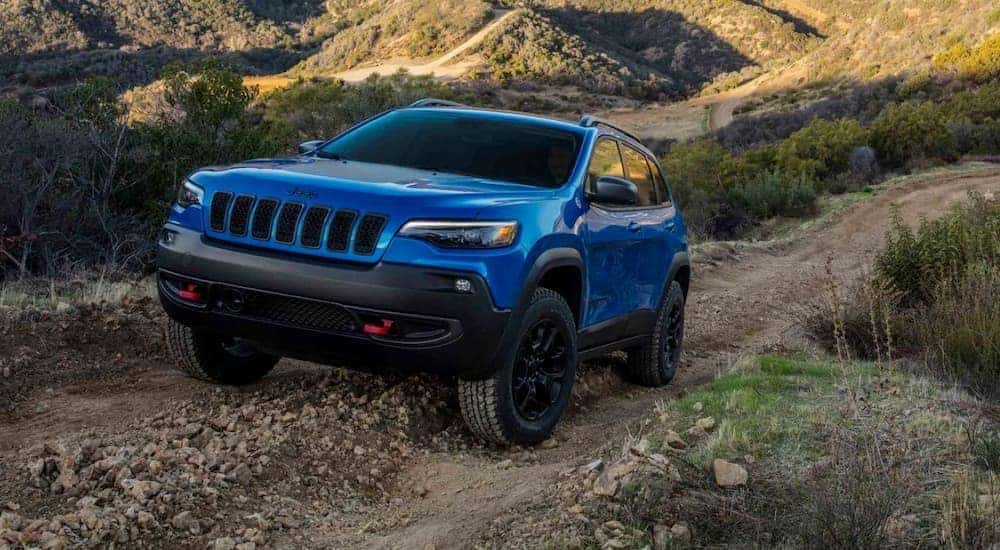
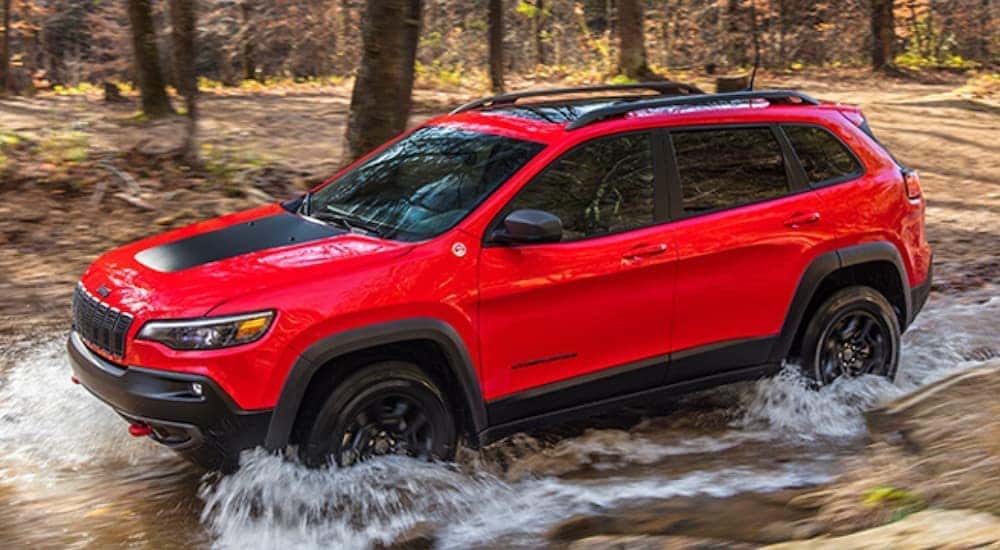
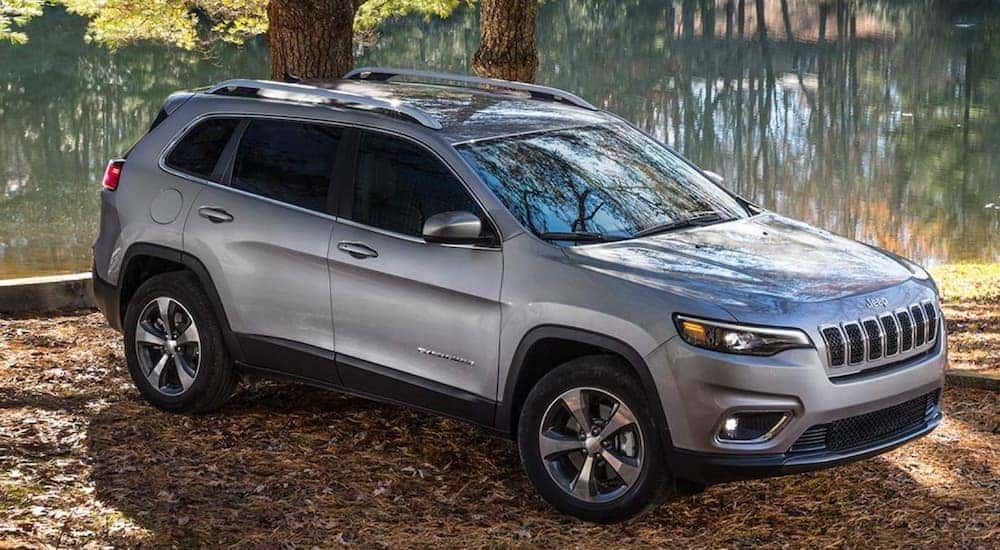 You have options when it comes to shopping for your next vehicle, and if you're looking at used models, you may be surprised at all the decisions you'll need to make. Once you've decided that a used Jeep Cherokee is the best fit for you, you'll want to explore pre-owned versus certified pre-owned (CPO) status. When a vehicle is a certified pre-owned model, it has met some extra requirements that standard used vehicles have not, and these standards will vary from brand to brand. Typically, the models considered for CPO programs across the board are newer models that have low mileage and have clean vehicle history reports. Now although these vehicles may appear to be the better options, that's not always the case.
Pre-owned vehicles can be just as solid as CPO vehicles without the hefty price tag. You see, once a used vehicle has gained CPO status, prices may go up, leading many used car shoppers to overpay for their next vehicle. We advise you to work with a trusted dealership to ensure that you're getting the most dependable vehicle at a price that's fair and within your budget.
You have options when it comes to shopping for your next vehicle, and if you're looking at used models, you may be surprised at all the decisions you'll need to make. Once you've decided that a used Jeep Cherokee is the best fit for you, you'll want to explore pre-owned versus certified pre-owned (CPO) status. When a vehicle is a certified pre-owned model, it has met some extra requirements that standard used vehicles have not, and these standards will vary from brand to brand. Typically, the models considered for CPO programs across the board are newer models that have low mileage and have clean vehicle history reports. Now although these vehicles may appear to be the better options, that's not always the case.
Pre-owned vehicles can be just as solid as CPO vehicles without the hefty price tag. You see, once a used vehicle has gained CPO status, prices may go up, leading many used car shoppers to overpay for their next vehicle. We advise you to work with a trusted dealership to ensure that you're getting the most dependable vehicle at a price that's fair and within your budget.